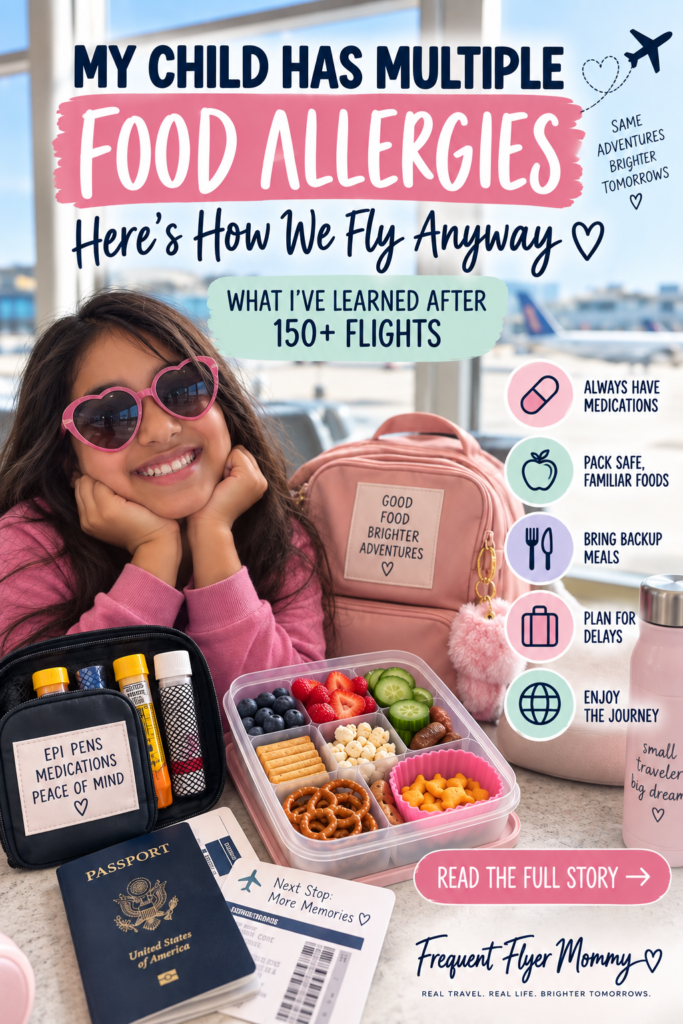
This post contains affiliate links. If you purchase through one of my links, I may earn a small commission at no additional cost to you. I’ve taken more than 150 flights with my daughter, including both domestic and international travel. She also has multiple food allergies, which means that getting on a plane requires a little more planning for us than simply deciding what snacks to throw into a carry-on. Over the years, I’ve developed a routine that helps me feel prepared without allowing her food allergies to take the fun out of traveling. Because whether we’re taking a short domestic flight or heading halfway around the world, my philosophy is pretty simple: Medication first. Safe food second. And always have a backup plan. 1. Before Anything Else: EpiPens and Medications Before I think about snacks, entertainment or what we’re going to eat at the airport, I think about medication. I always make sure I have my daughter’s EpiPens and any other medications we could possibly need during our travels. They stay with me in my carry-on where I can get to them quickly—not packed away in checked luggage. This is something I do whether we’re taking a quick domestic flight or traveling internationally. When we’re going overseas, I’m even more conscious of being prepared because I don’t want to assume that I’ll easily find the same medication, brand or dosage once we arrive. Every child’s medical needs are different, so families should always follow their own child’s prescribed allergy and emergency plan. For me, the important thing is knowing that I have what my daughter needs with me before we leave home. Once I’ve taken care of that, I can think about food. 2. I Never Assume We’ll Find Something Safe to Eat One thing 150+ flights have taught me is that I can’t depend entirely on airport or airline food. Even when an airport has plenty of restaurants, that doesn’t necessarily mean there will be something that works for my daughter. Maybe the ingredients aren’t clear. Maybe I’m concerned about cross-contact. Maybe the restaurant we planned to visit is in another terminal. Maybe it’s closed. Maybe our flight is delayed and everything closes before we get there. Or maybe my daughter simply doesn’t want the one safe option we can find. So I don’t make airport food our only plan. If we find something that works, wonderful. But I want to know that we have enough food with us if we don’t. 3. I Don’t Just Pack Snacks—I Pack Food That Can Become a Meal This is probably one of the biggest differences between how I used to prepare for flights and how I prepare now. Snacks aren’t the same thing as meals. A bag full of crackers, chips and little treats might get us through a short flight. It isn’t necessarily going to help when a travel day unexpectedly becomes several hours longer. That’s why I bring some foods that can actually serve as a meal if needed. Instant mac and cheese cups are one example for us. They’re familiar, my daughter likes them, and if I can get hot water, I have something more substantial to give her. I’m not suggesting that every parent needs to travel with mac and cheese. The right backup food is going to depend completely on your child’s allergies and what they can safely eat. The lesson I’ve learned is simply this: Bring at least one food that can become a real backup meal. It has saved us from the stress of trying to figure out what to feed a hungry child when our original plan doesn’t work. 4. I Make Her Snacks Something She Gets Excited About This is one of my favorite parts of preparing for a trip. When your child has food allergies, they already have to hear some version of “No, you can’t have that” more often than you’d like. I don’t want travel day to feel like another list of things she can’t have. So I try to turn the food I bring into something fun. One of my favorite ways to do this is with a snackle box. Instead of packing one or two large bags of snacks, I fill the individual compartments with different things my daughter likes. She gets variety, and opening it feels a little like discovering a tray full of treats. I can include something crunchy, something sweet, something salty and a few little surprises. It sounds simple, but on a long travel day, presentation can make a difference. Instead of feeling like she’s eating the food Mommy had to bring because she can’t have something else, she has her own special travel snack box. And she genuinely gets excited about it. 5. If I’m Packing Fruit, I Bring an Ice Pack I also don’t want everything she eats during a long travel day to come out of a package. When it makes sense for our trip, I like bringing fruit and other foods that need to stay cool. For those trips, I use an insulated snack container that comes with a small carrying bag and reusable ice pack. This is the insulated snack container I use: https://amzn.to/4qH4ufR I like it because I can give my daughter more variety while keeping cold foods cold for part of our travel day. Of course, rules about liquids, ice packs, fresh fruit, produce and what can be carried through security or brought into another country can vary. I always recommend checking the current security and destination requirements before traveling rather than assuming something is allowed. 6. I Pack for the Delay, Not Just the Scheduled Flight If there’s one thing frequent flying teaches you, it’s that the itinerary on your phone isn’t necessarily how the day is going to go. Flights get delayed. Connections get missed. Weather happens. You can sit on a plane longer than expected. A three-hour layover can turn into six. You can land at your destination late at night and discover that the restaurants you planned to use are already closed. So when I’m deciding how much food to bring, I don’t only think: “How long is our flight?” I think: “What would I need if this travel day went completely sideways?” That means bringing more than I expect her to eat. I’d much rather arrive with leftover snacks than find myself several hours into a delay with a hungry child and no safe option I feel comfortable giving her. 7. Familiar Foods Are Important to Us Travel already comes with so much change for a child. We’re waking up at strange times, going through airports, sitting on airplanes, sleeping in unfamiliar places and sometimes dealing with completely different time zones. For us, food doesn’t need to be another unknown. That’s why I make sure some of the things I bring are foods my daughter already knows and likes. I’m not trying to introduce a new allergy-friendly snack for the first time at 35,000 feet. I want things I know she’ll actually eat. There is a big difference between having food available and having food your child will actually eat when they’re exhausted and hungry. After a lot of travel, I’ve learned to plan for the second one. 8. International Travel Requires an Extra Layer of Research I use the same basic system whether we’re flying domestically or internationally, but traveling to another country requires additional planning. At home, I know our grocery stores. I recognize brands. I’m familiar with labels. I know which restaurants tend to work for us. In another country, I may know none of those things. So before we leave, I research more than hotels and sightseeing. I want to know: Where is the closest grocery store to our hotel? Will we have access to a refrigerator? Is there a microwave? What food options are around our hotel? Are there familiar brands available? Are there foods I should bring from home because they may be difficult to find there? Are there restrictions on bringing certain foods into the country? Ingredient labels, formulations and food-allergen labeling can also differ between countries, so I don’t automatically assume that a familiar-looking product is identical to the version we buy at home. That little bit of research before we leave can save a tremendous amount of stress once we arrive. 9. I Keep the Important Things Accessible There is no point in bringing something important if I can’t get to it when I need it. That’s why medications stay with me, and I keep enough food easily accessible during the journey. I don’t want something we may need during the flight buried inside checked luggage. I also organize our carry-on so I don’t have to completely unpack it every time my daughter asks for something. After 150+ flights, I’ve learned that accessibility matters almost as much as remembering to bring something in the first place. 10. Food Allergies Don’t Have to Take the Adventure Out of Travel This is the part I care about most. My daughter has food allergies. That’s part of our reality, and it means I have to think about certain things another parent might not have to consider. But I don’t want her to grow up thinking that her allergies mean she can’t see the world. We’ve traveled. We’ve taken long flights. We’ve gone to new places. We’ve made wonderful memories. I simply do more preparation behind the scenes. The EpiPens and medications come first. Then I make sure I have safe foods. I bring backup meals. I pack more than I think we’ll need. I make her snackle box something she’s excited to open. And when we’re traveling internationally, I do my research before we arrive. All of those little things give me something incredibly valuable when we’re actually on the trip: the ability to focus less on what could go wrong and more on experiencing where we are. The Travel Rule I Follow After 150+ Flights If I had to reduce everything I’ve learned to one rule, it would be this: Prepare for the trip you’re taking—and have a plan for the travel day you didn’t expect. For our family, that means medications first, plenty of safe and familiar food, something substantial enough to become a backup meal, and extra food for delays. And I still make it fun. Because my daughter’s travel memories shouldn’t be about all the foods she couldn’t eat. I want them to be about the places she got to see.
This article shares my personal experience traveling with my daughter and is not medical advice. Every child’s allergies and medical needs are different. Follow your child’s prescribed allergy and emergency action plan and speak with their healthcare professional about travel preparation. Before flying, check current airline, airport/TSA and destination-country requirements for medications, food, ice packs and agricultural products. This post contains affiliate links. When you purchase through one of my links, I may receive a small commission at no additional cost to you. I only share products that fit into our real-life travel routine.
 By
/ September 4, 2026
By
/ September 4, 2026